
Technical guide · 100V line
100V line PA systems: taps, cable and coverage
A 100V line drives many loudspeakers over long cable runs at a constant voltage. The design is decided by the total tap load, the cable and the coverage — not by the amplifier label alone.
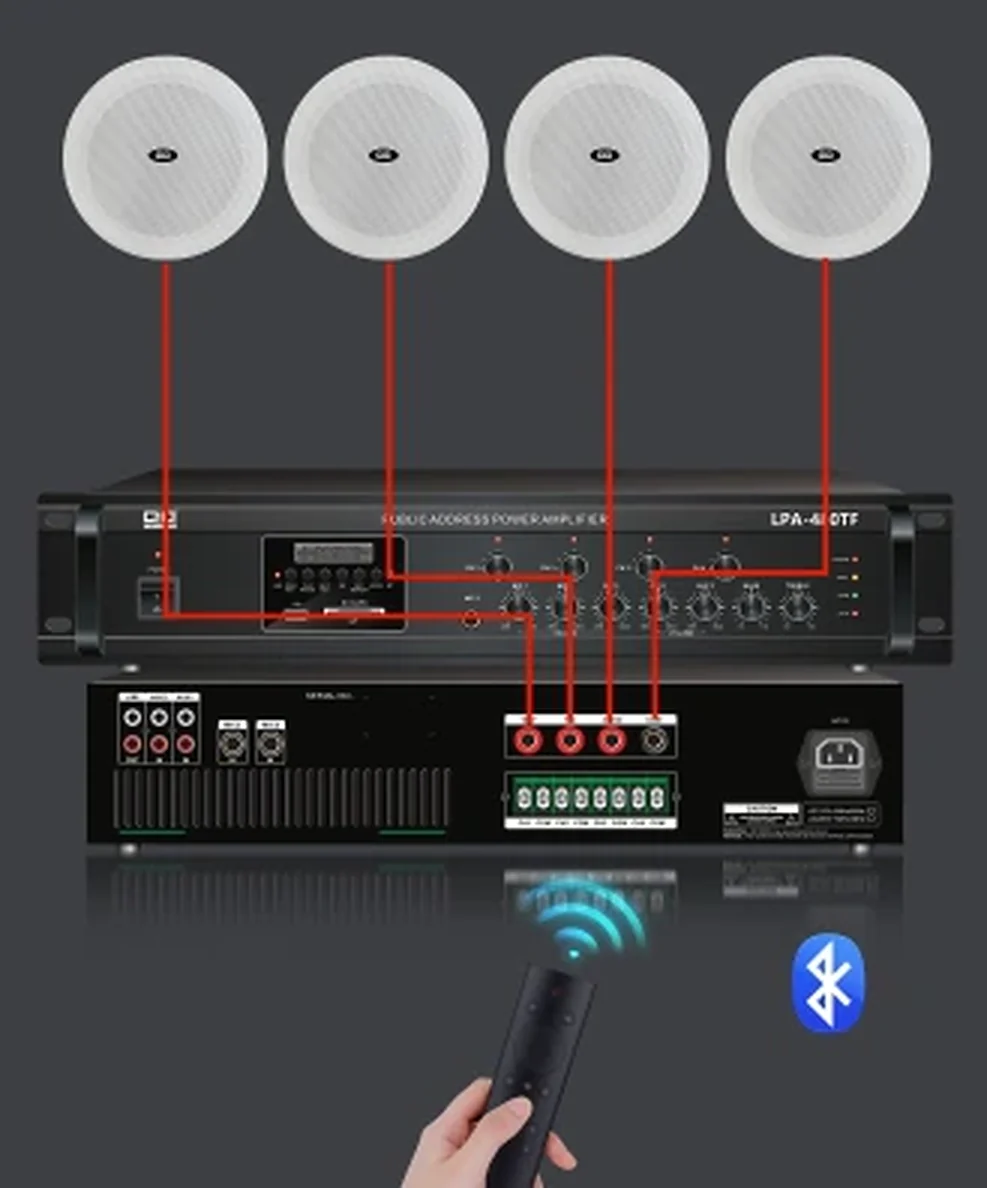
In short: sum every loudspeaker tap, add 1.25–1.5× headroom, check voltage drop, and keep listeners within 15 m (8 m at a corridor end). Emergency level: +15 dB above ambient.
In short: sum every loudspeaker tap, add 1.25–1.5× headroom, check voltage drop, and keep listeners within 15 m (8 m at a corridor end). Emergency level: +15 dB above ambient.
What is a 100V line system?
A 100V line is a constant-voltage distribution method. The amplifier output is stepped up to 100V, and each loudspeaker has a transformer with a tap setting. The high voltage keeps the current low over long cable runs.
It is not a “safe low voltage”. Treat the line as live, use qualified installation and follow the local electrical code. The advantage is distribution, not safety.
100V line basics
| Item | Reference |
|---|---|
| Output voltage | 100V constant voltage |
| Loudspeaker | Transformer with tap (e.g. 3W / 6W / 15W) |
| Connected load | Sum of every tap on the circuit |
| Amplifier | Connected load + 1.25–1.5× headroom |
| Cable | Sized by current and voltage drop |
| Fire interface | Hard-wired override, independent of music |
Values are design references. The offered model and tap are confirmed in the quotation.
How do you calculate the tap load?
Add the tap wattage of every loudspeaker on the circuit. A 3W ceiling speaker and a 15W horn are not interchangeable in the load calculation. Split the circuits by zone and by cable route.
Then compare the total with the amplifier rating. If the load is close to the rating, there is no room for a future speaker or a higher tap. Current on a 100V line is the total wattage divided by 100V.
Tap load example
| Item | Value |
|---|---|
| 20 ceiling speakers × 3W | 60 W |
| 10 horn speakers × 15W | 150 W |
| Connected load | 210 W |
| Amplifier with 1.3× headroom | 273 W |
| 100V line current | 2.1 A |
| Check | Cable drop and circuit protection |
How do you check cable size and voltage drop?
Cable size follows the current, the route length and the permitted voltage drop. A long run with a high tap load loses more level than a short run. Check the loop resistance and the drop at the last loudspeaker.
There is no single “maximum distance” for a 100V line. Two projects with the same cable can have different results because the load and the route are different. Calculate the drop, then split the circuit or increase the conductor size.
- Current = total tap wattage ÷ 100 V.
- Check the voltage drop at the last loudspeaker, not only at the amplifier.
- Keep power and signal cables separated where possible.
- Use the correct cable type for the installation environment.
How do you set coverage and emergency level?
The 100V line does not fix the acoustics. Keep any listener within 15 m of the nearest loudspeaker and the last corridor loudspeaker within 8 m of the corridor end. Set the tap to reach the required level in the actual noise.
For voice alarm, the emergency message should be at least 15 dB above the ambient noise. Test it in the room, not only on the amplifier meter. The fire override must be hard-wired and independent of the music source.
What are the common 100V line mistakes?
Most failures come from the load or the cable, not the amplifier. Check the tap settings, the circuit split and the voltage drop before the equipment is ordered.
- Setting every loudspeaker to the maximum tap.
- Mixing 8Ω loudspeakers and 100V transformer loudspeakers on one line.
- Ignoring the corridor-end rule or the last listener distance.
- Sizing the cable by habit instead of by current and drop.
- Using a music amplifier as a voice alarm without a monitored fire interface.
A 100V line is a load and voltage-drop design. Sum the taps, size the cable, check the coverage, then choose the model and confirm it in the quotation.
Related pages
Questions
Frequently asked questions
The questions that usually decide the scope: loudspeaker count, amplifier size, fire interface, certification and who installs the system. If your question is not here, send it with the building data.
Ask an application engineerIs 100V safe to touch?
No. Treat a 100V line as live. Installation and fault-finding must be carried out by a qualified electrician, following the local electrical code and the amplifier manufacturer’s instructions.
Can I use 70V instead of 100V?
Some markets and amplifiers use 70V. The principle is the same, but the amplifier, the loudspeaker taps and the load calculation must match. Confirm the voltage before ordering.
How many loudspeakers can one 100V line carry?
The limit is the total tap load and the amplifier headroom, not a fixed speaker count. Sum the taps, compare with the amplifier rating, and leave room for future changes.
Can I mix 8Ω and 100V loudspeakers on one line?
No. They are different distribution methods. A 100V line needs transformer loudspeakers; an 8Ω loudspeaker needs a low-impedance amplifier or a suitable transformer.
How far can a 100V line run?
It depends on the total current, the cable size and the permitted voltage drop. There is no single distance. Calculate the drop for the actual route and load, then split the circuit if needed.
One brief, one combined proposal
Send the building once. Get the whole system back.
Tell us the building type, zones, room sizes, ceiling height, seat or table count, fire interface and any ODM/OEM requirement. Our own factory and system team return one combined proposal: equipment schedule, interface list and open questions.
Reply within 48 hours · drawings welcome · no obligation